Frequently asked questions
What is piano tuning?
Piano tuning is the process of bringing the notes of the chromatic scale into harmony with one another on upright and grand pianos, using temperament based on fourths and fifths or thirds and sixths.
Which areas do you serve?
We work throughout Berlin: Mitte, Friedrichshain-Kreuzberg, Pankow (including Prenzlauer Berg), Charlottenburg-Wilmersdorf, Spandau, Steglitz-Zehlendorf, Tempelhof-Schöneberg, Neukölln, Treptow-Köpenick, Marzahn-Hellersdorf, Lichtenberg and Reinickendorf.
We also travel to the surrounding area: Potsdam, Kleinmachnow, Teltow, Stahnsdorf, Falkensee, Hennigsdorf, Oranienburg, Bernau, Strausberg, Erkner, Königs Wusterhausen, Schönefeld, Blankenfelde-Mahlow, Dallgow-Döberitz and other towns. Further locations are available on request.
How often should my piano be tuned?
A piano should be tuned at least once a year. If you play frequently, it may need tuning more often. We recommend tuning your piano twice a year to keep it in excellent condition.
How long does piano tuning take?
The time needed can vary, usually depending on the piano’s condition and when it was last serviced. On average, tuning takes around one to two hours.
How long does a piano stay in tune?
How well a piano holds its tuning depends on several factors, including changes in temperature and humidity, the instrument’s age and how often it is played. A professional tuning generally lasts around six months to a year.
Are electronic tuning devices better than tuning by ear?
Both tuning by ear and using electronic tuning devices have advantages and disadvantages. An experienced piano tuner can achieve excellent results with either method. The choice depends on the tuner’s individual preferences and skills.
Can I tune my piano myself?
We do not recommend tuning your piano yourself, as this can cause irreparable damage. Piano tuning requires experience and specialist knowledge to avoid damaging the instrument. It is best left to an experienced piano tuner.
How much will it cost to repair my piano?
The cost depends on the type and extent of the repairs. Contact us for a free consultation and a repair estimate.
How can I book an appointment?
You can contact us by messenger, call +49 176 66 99 33 03, or use the contact form to arrange an appointment. We will be happy to answer your questions and help you book.
What is a piano pitch raise?
A pitch raise increases the tension of all the piano’s strings to reach a particular pitch. This is necessary when a piano gradually loses its tuning: the strings lose tension and begin to sound lower than the intended reference pitch.
Why can a pitch raise be risky for a piano?
A pitch raise increases string tension, placing additional stress on the frame and other supporting structures. If carried out incorrectly, for example by raising the pitch too quickly or unevenly, it can damage the frame, cause cracks or other deformation, and seriously harm the instrument.
Can a piano’s pitch be raised by several semitones in one pass?
Although this is technically possible, it increases the risk of damage to the instrument. We recommend raising the pitch gradually, by no more than one semitone at a time, to minimise the risks and distribute the load evenly across the strings and supporting structures.
How can I help my piano stay in tune?
An appropriate and stable room climate is essential:
- Temperature: a constant 20°C
- Humidity: 45–60%.
- Exceptionally loud, forceful playing can also affect tuning. Gentle playing helps the piano stay in tune longer.
Does my piano need tuning even if it has rarely been played?
Changes in temperature and humidity, and the piano settling over time, cause it to go out of tune, rather than playing itself. How often it is played rarely has a major effect on tuning unless it is played exceptionally hard.
Can leaving a piano untuned damage it?
A severely out-of-tune piano can suffer damage, although this is rarely irreparable. A piano adapts to the tension of its strings. When it goes out of tune, string tension decreases and the piano adjusts to this lower tension. When the strings are brought back to the correct pitch, the piano usually needs days or weeks to adjust again. Neglected pianos therefore often need two or more tunings to achieve stability, while well-maintained pianos hold their tuning better.
My technician says my piano needs a “pitch adjustment” before tuning. What does this mean?
A pitch adjustment, or pitch correction, brings the piano close to the correct pitch by adjusting string tension. The tuner may need to make one or more pitch corrections, depending on how far the piano is from the intended pitch. If your piano is not tuned regularly, its strings lose tension and the sound becomes dull and blurred. Modern pianos are designed to be tuned to A4 — the A above middle C — at 440 vibrations per second. The piano sounds its best at this pitch, which also allows the pianist to play with other instruments.
Does pitch correction cost extra?
Yes. The cost depends on how many pitch corrections are needed to bring your piano close to the intended pitch.
Is pitch correction really necessary?
Yes 😊. If your piano is significantly off pitch, a fine, accurate tuning is impossible. Without pitch correction, the tuning will not last and you will be disappointed with the result. We always carry out pitch correction when it is necessary because we value your satisfaction and our reputation for high-quality piano tuning.
Why is regular piano tuning important?
Regular tuning is essential to maintain the best possible sound and the longevity of your instrument. Even small changes in temperature and humidity can affect its tuning. We recommend having your piano tuned at least once a year for an optimal sound and playing experience.
My piano does not stay in tune for long. What could be wrong?
Several problems could be responsible. Most often, the pinblock is not holding the tuning pins firmly enough. If a tuning pin in the pinblock is loose, it can slip and release tension on the string. Sometimes a piano technician can provide a simple remedy, but often the pinblock is worn out. Other tuning problems are caused by the piano’s surroundings rather than the instrument itself. Stabilising the temperature and humidity around the piano can help.
A piano tuner said my piano cannot be tuned. Why?
This does not necessarily mean your piano needs to be replaced. Loose tuning pins often no longer hold string tension reliably, so tuning alone would not last. At PIANOHOF, we also repair instruments that other piano tuners have declined to tune. There are several ways to repair loose tuning pins. We can usually carry out this work at your home; transporting the piano to the workshop is often unnecessary. We first check which solution suits your piano’s condition and agree the scope and costs with you. Please send us photographs and the previous tuner’s assessment.
Where is the best place for a piano at home?
An upright or grand piano is best placed somewhere with a reasonably stable temperature and relative humidity, away from direct sunlight, radiators and air vents. A suitable interior wall is often a good choice. If the instrument has to stand near a window, protect it from direct sunlight with blinds or curtains and avoid draughts. A grand piano’s large lid in particular can become very warm in the sun and transfer heat to the interior. Temperature changes affect tuning, while excessively dry air can damage the soundboard and other wooden parts. Opening the upper case lid can help air circulate so that warm air escapes more easily. On a grand piano, this means the large lid; on an upright, it means the lid above the action, rather than the keyboard cover. Only open the lid using its intended safe support. Opening it does not replace protection from sunlight or reasonably stable, appropriate humidity. Monitor the room climate with a hygrometer and do not direct warm or cold airflow at the instrument.
What is “concert tuning”?
Concert tuning is the careful tuning of an upright or grand piano for a concert performance. The priorities are clean harmonies, balanced tuning across the keyboard and the greatest possible tuning stability. The intended pitch is agreed with the participating musicians. A4 = 440 Hz is a common reference, but it is not the definition of concert tuning. Depending on what is needed, concert preparation may also include voicing and action regulation; these are separate adjustments to the sound and touch. If an instrument does not hold its tuning, the cause must first be identified. Restoration is not automatically required.
My piano has not been tuned for years. Can it still be tuned?
Yes, but it will very probably need pitch correction.
I rarely play my piano, so it should not go out of tune — should it?
A piano actually starts drifting out of tune almost immediately after tuning. Our ears simply cannot detect it until the change becomes noticeable. Whether you play it or not, it will eventually reach a point where you can clearly hear that it is out of tune.
How should I prepare for the piano tuner’s visit?
Remove everything from the piano, valuables nearby, and anything underneath a grand piano. Keep noise to a minimum if possible: tuning requires concentration and a quiet environment. If there is a problem with the piano, such as sticking keys, make a note of which keys are affected.
I have heard about piano humidifiers. Should I have one installed?
Installing a piano humidifier can be a good idea, especially where humidity varies widely. Pianos are made of wood, which expands and contracts as humidity changes. These changes can affect tuning and, over time, damage the wooden structure and action. A humidifier helps keep humidity around the piano stable, reducing the likelihood of tuning problems and damage from excessively dry or damp conditions. Correct installation and maintenance are important for it to work effectively.
My piano’s keys feel heavy. Can this be adjusted?
The short answer is yes, within certain limits. Several mechanical problems can contribute to a heavy touch. After assessing the piano, the technician can explain the adjustments needed, the likely result and the costs.
I have a broken string. Is this a serious problem?
Replacing a string is straightforward for a trained technician, and piano technicians usually carry strings with them. However, a new string may need several tunings. Your tuner may need to return more than once before the string holds its tuning. Bass strings sometimes have to be specially ordered, which takes longer.
What is voicing, and when is it needed?
Voicing changes a piano’s tone, within certain limits. Every piano has its own tonal character. Some have a warm, soft sound; others sound brighter or sometimes harsh. The sound changes over time as parts age. The hammers can become harder where they strike the strings, producing a harsher or brighter tone. If you prefer a different sound, if the piano sounds different from when you chose it in the showroom, or if the tone varies greatly between keys, consider asking your piano technician to voice it. Voicing involves working with the tuner, as you need to explain the sound you prefer.
What is action regulation, and how often is it needed?
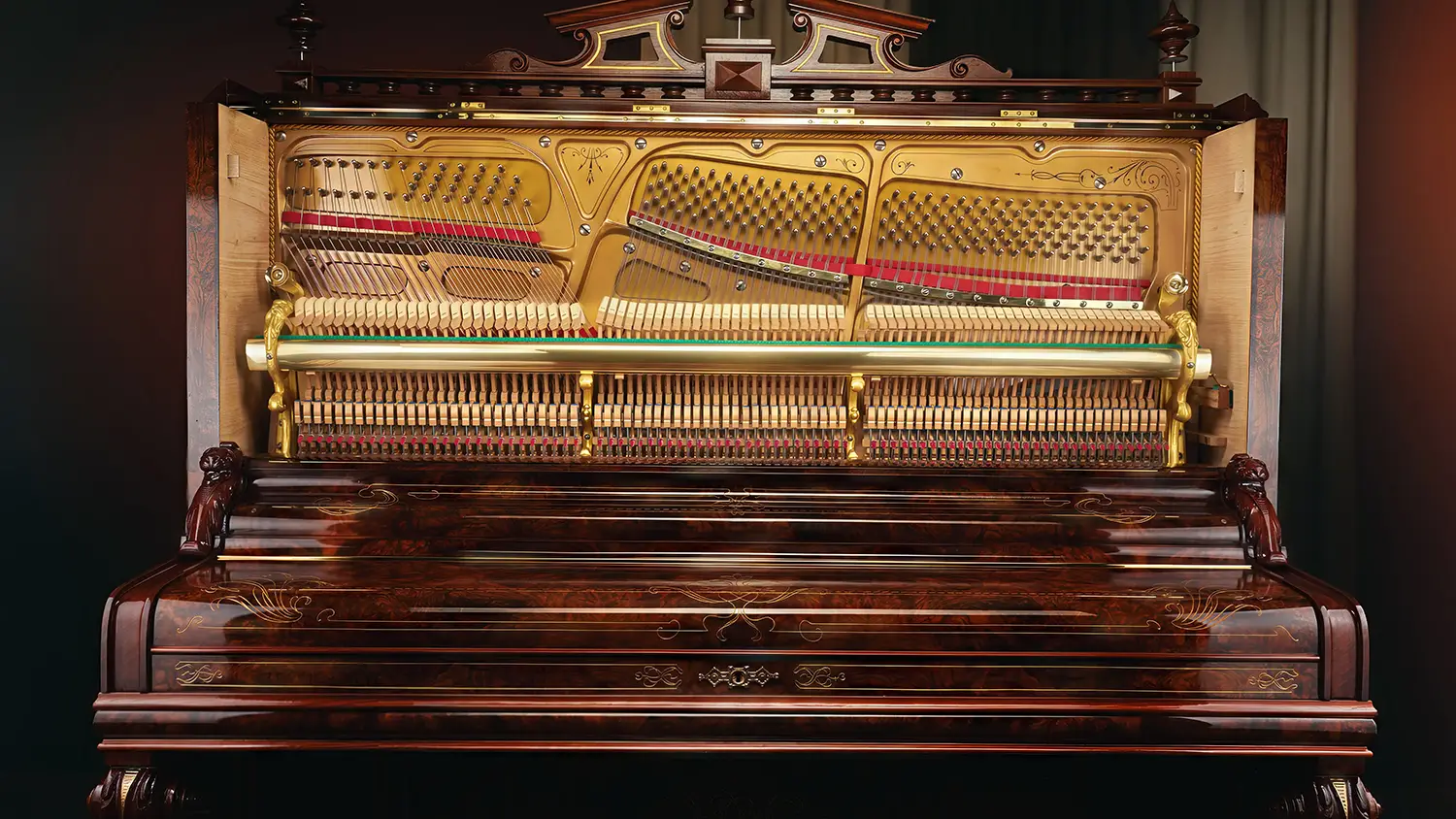
The action is the heart of a piano. It includes the keys, hammers, dampers and many other delicate moving parts that operate within close tolerances. Over time, these parts deteriorate and move away from their correct positions. This can cause broken parts, unplayable keys, a heavy touch, poor playability, reduced tonal control and accelerated wear. During regulation, the technician repairs or replaces parts as needed and adjusts them to work correctly together. A regulated piano provides maximum power, speed, control and an even touch.
My piano has just been delivered. Does it need tuning?
Pianos contain a great deal of wood and are affected by temperature changes and especially humidity. After moving your piano, let it settle in its final position for around two weeks before having it tuned. Keep it out of direct sunlight and away from heating and cooling equipment, including fireplaces.
Should my piano be tuned to 440 Hz or 442 Hz?
Pianos are generally recommended to be tuned to 440 Hz, the international reference pitch for A, to which most orchestras and other instruments are tuned. In some cases, especially in classical music and certain European countries, 442 Hz is preferred for a brighter sound. The choice depends on your personal preferences and how you use your piano.
Does my piano need a humidifier in Berlin?
Relative humidity of 40–60% helps keep the tuning stable and protects the wood. If humidity stays below 35% in winter, we recommend a room humidifier or an integrated system. Use a hygrometer, maintain the system regularly, use clean water and avoid humidity above 65%.